
qsensor-sim
A physics-based quantum sensor simulation API for GPS-denied navigation research — synthetic IMU data with quantum decoherence effects, processed through Kalman filtering and bias correction.
The constraint
Quantum inertial sensors are a serious answer to GPS-denied navigation, but the hardware is scarce and classified-adjacent. Anyone wanting to develop the signal processing that sits downstream of such a sensor has no data to develop against.
The approach
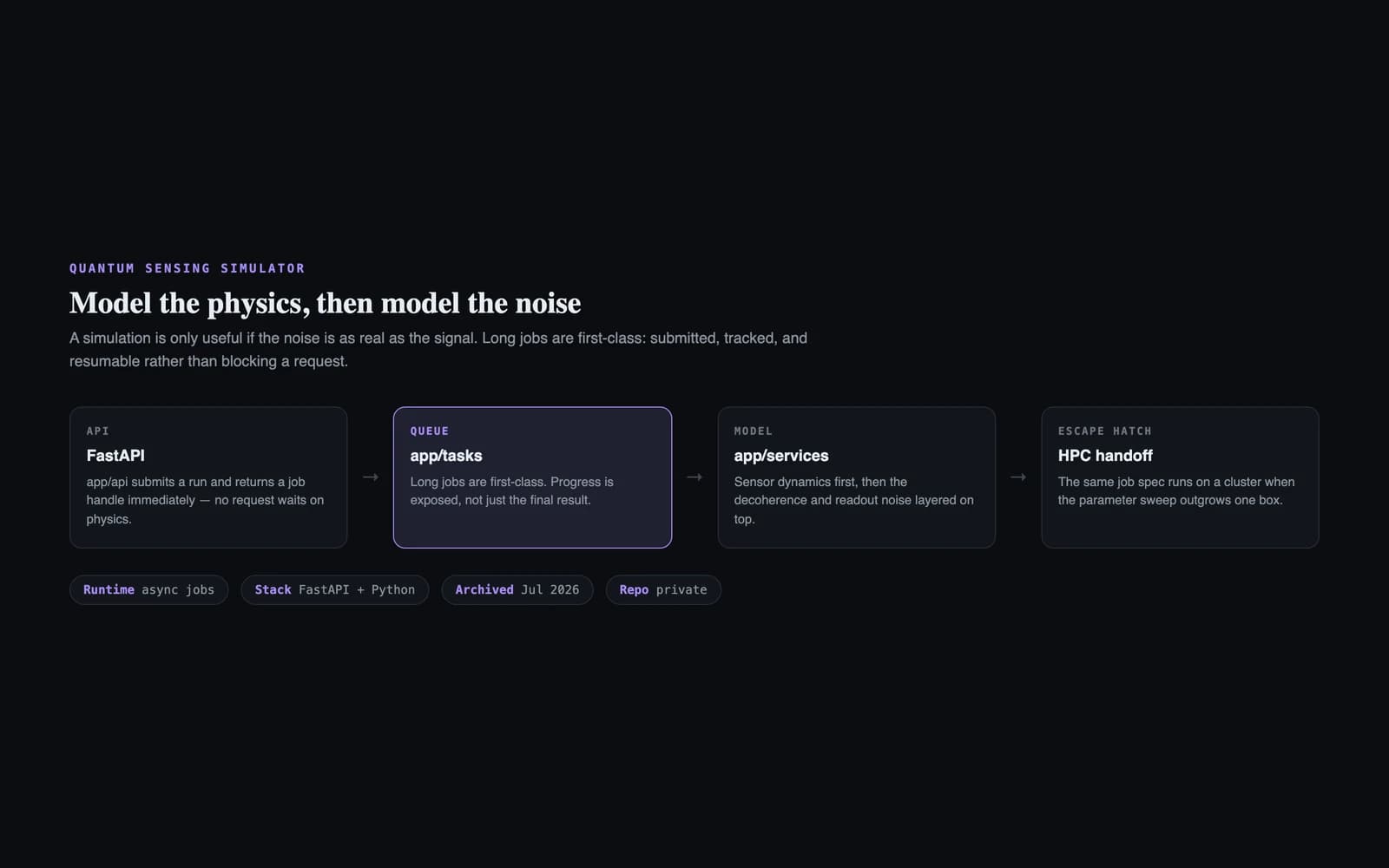
Simulate the sensor instead. Generate physics-based trajectories, apply realistic noise and quantum decoherence effects, then run the synthetic output through the same calibration and filtering stack real navigation data would face — Kalman filtering, complementary filtering, and bias correction — exposed as an async job API.
- 1Model the physics, then the noise
Generated clean trajectories first and layered noise and decoherence on top, so the ground truth stays available for evaluating the filters.
- 2Make long jobs first-class
Pushed simulation onto Celery workers with Redis as the broker, since a physically meaningful run is not a request-response operation.
- 3Expose progress, not just results
Added job status and progress endpoints so a caller can tell the difference between slow and stuck.
- 4Keep an HPC escape hatch
Left an optional gRPC service alongside the REST gateway for cases where the numerical work outgrows the Python worker.
Outcomes
- Physics-based trajectory generation with quantum decoherence modeling
- Kalman and complementary filtering with bias correction on the processing side
- Asynchronous job processing via Celery and Redis with progress tracking
- FastAPI REST gateway with auto-generated docs, containerized for Docker and Kubernetes
- Validate the noise model against published characterizations of real cold-atom interferometers.
- Add a benchmark suite comparing filter families on identical synthetic runs.
- Ship reproducible scenario definitions so results can be cited and re-run.
Built a quantum sensor simulation API for GPS-denied navigation research, generating synthetic IMU-like data with physics-based trajectories and quantum decoherence effects, then processing it through calibration and filtering to clean navigation outputs.
Implemented asynchronous job processing with Celery and Redis behind a FastAPI gateway, with progress tracking, auto-generated API docs, and Docker/Kubernetes deployment support.
Related projects
- Read →
Cocoon
A privacy-first Chrome extension that lowers sensory load online: it softens algorithmic feeds, reduces motion, and keeps a grounding exercise one click away. No accounts, no analytics, nothing leaves the device.
- Read →
unlinkd
Get yourself removed from the internet — and keep the proof. A local-first, fully encrypted workspace for data-broker removal requests and the tamper-evident paper trail a GDPR or CCPA escalation actually needs.
- Read →
FraudStream
A production-grade streaming pipeline that scores financial transactions for fraud in milliseconds rather than hours, built on Kafka, Spark Structured Streaming, and a Snowflake medallion warehouse.