
FraudStream
A production-grade streaming pipeline that scores financial transactions for fraud in milliseconds rather than hours, built on Kafka, Spark Structured Streaming, and a Snowflake medallion warehouse.
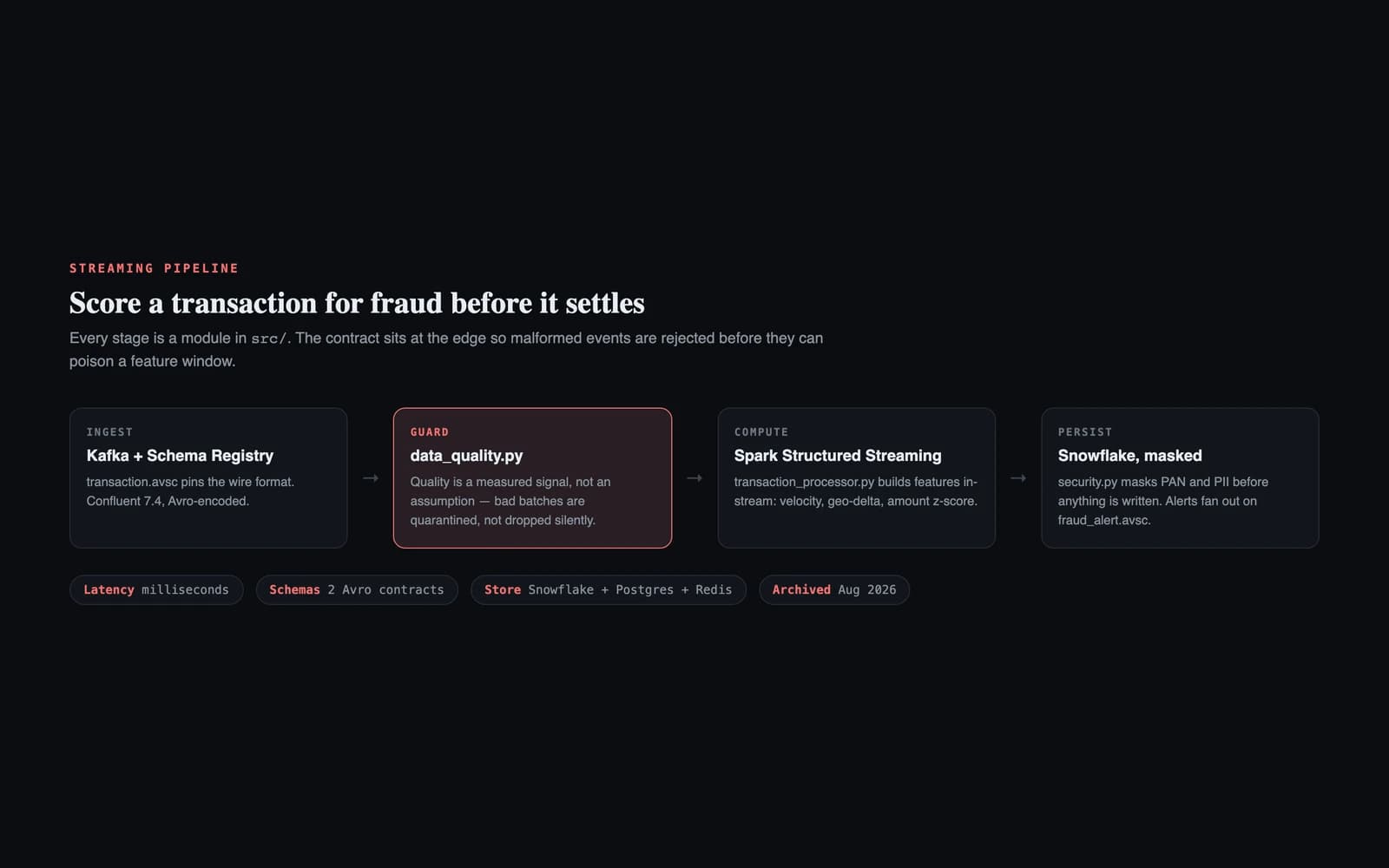
The constraint
Financial institutions process thousands of card transactions a second, and hidden among them are account takeovers, card-testing attacks, and synthetic-identity fraud. Traditional batch processing surfaces these hours or days later — by which point the money is gone and the job is recovery, not prevention.
The approach
A streaming pipeline where transactions arrive through Kafka under Avro schema validation, pass multi-level data-quality checks, get enriched with velocity and anomaly features in Spark Structured Streaming, and land in Snowflake's Bronze/Silver/Gold layers. PII is masked with HMAC-SHA256 before anything is stored.
- 1Contract at the edge
Put Avro and a Schema Registry at ingestion so malformed producers fail at the boundary rather than corrupting downstream layers.
- 2Quality as a measured signal
Layered required-field, type, range, and business-rule checks, then scored and trended quality so degradation triggers an alert instead of a silent drift.
- 3Feature engineering in-stream
Calculated velocity metrics, risk scores, and geographic anomalies inside the streaming job so detection does not wait on a batch window.
- 4Mask before you store
Applied HMAC-SHA256 to PII before the Bronze layer, so no raw identifier is ever written to the warehouse at rest.
Outcomes
- Eight distinct fraud patterns detected, including card testing, geographic impossibility, merchant collusion, and bust-out fraud
- Sub-second latency from transaction to alert
- Schema validation via Avro and a Schema Registry, with quality scoring and trend monitoring
- ML-ready feature set so a model can be dropped in without re-plumbing the pipeline
- Replace the rules layer with a trained model and hold the rules as a fallback and a baseline.
- Add drift detection on the feature distributions, not just the data-quality checks.
- Run a replay harness against labelled historical fraud to get real precision/recall numbers rather than pattern coverage.
Engineered a real-time fraud detection pipeline processing financial transactions through Kafka, Spark Structured Streaming, and Snowflake, detecting eight fraud patterns with sub-second transaction-to-alert latency.
Implemented Avro schema validation, multi-level data quality checks with scoring and trend monitoring, and HMAC-SHA256 PII masking ahead of the Bronze layer.
Related projects
- Read →
Cocoon
A privacy-first Chrome extension that lowers sensory load online: it softens algorithmic feeds, reduces motion, and keeps a grounding exercise one click away. No accounts, no analytics, nothing leaves the device.
- Read →
unlinkd
Get yourself removed from the internet — and keep the proof. A local-first, fully encrypted workspace for data-broker removal requests and the tamper-evident paper trail a GDPR or CCPA escalation actually needs.
- Read →
Talker
An open source teaching assistant that answers course questions from the syllabus, slides and lecture materials — with citations, and YouTube timestamps when a video covers the answer.