
The Water Wars Are Already Here
Two billion people already lack reliable drinking water, and the conflicts over what's left are well underway.
Lorenzo ScaturchioLos AngelesAbout the author →
ExplorePlace & climatePower & institutions
Stop saying "coming"
Every few months someone publishes an article warning that water wars are "coming." That climate change "could" create water conflicts. That we "might" face shortages by 2050.
This framing is a lie of tense. The water wars are here — fought in courtrooms, legislatures, international tribunals, and occasionally with actual weapons. Two billion people on this planet lack reliable access to safe drinking water, according to the WHO's 2023 joint monitoring report. Nobody is projecting that figure. The WHO counted.
The future tense persists because the people writing the warnings mostly live in places where you turn the tap and water comes out. Their crisis hasn't arrived yet. For a large part of humanity it arrived a long time ago, and the articles keep promising it anyway.
The Colorado is a ghost
If you want to understand the water crisis without leaving the United States, start with the Colorado River.
The Colorado River Compact of 1922 divided the river's water among seven states based on flow measurements taken during an abnormally wet period. The compact allocated more water than the river actually carries in a normal year. This was known almost immediately, and ignored for decades, because there was enough surplus to paper over the math.
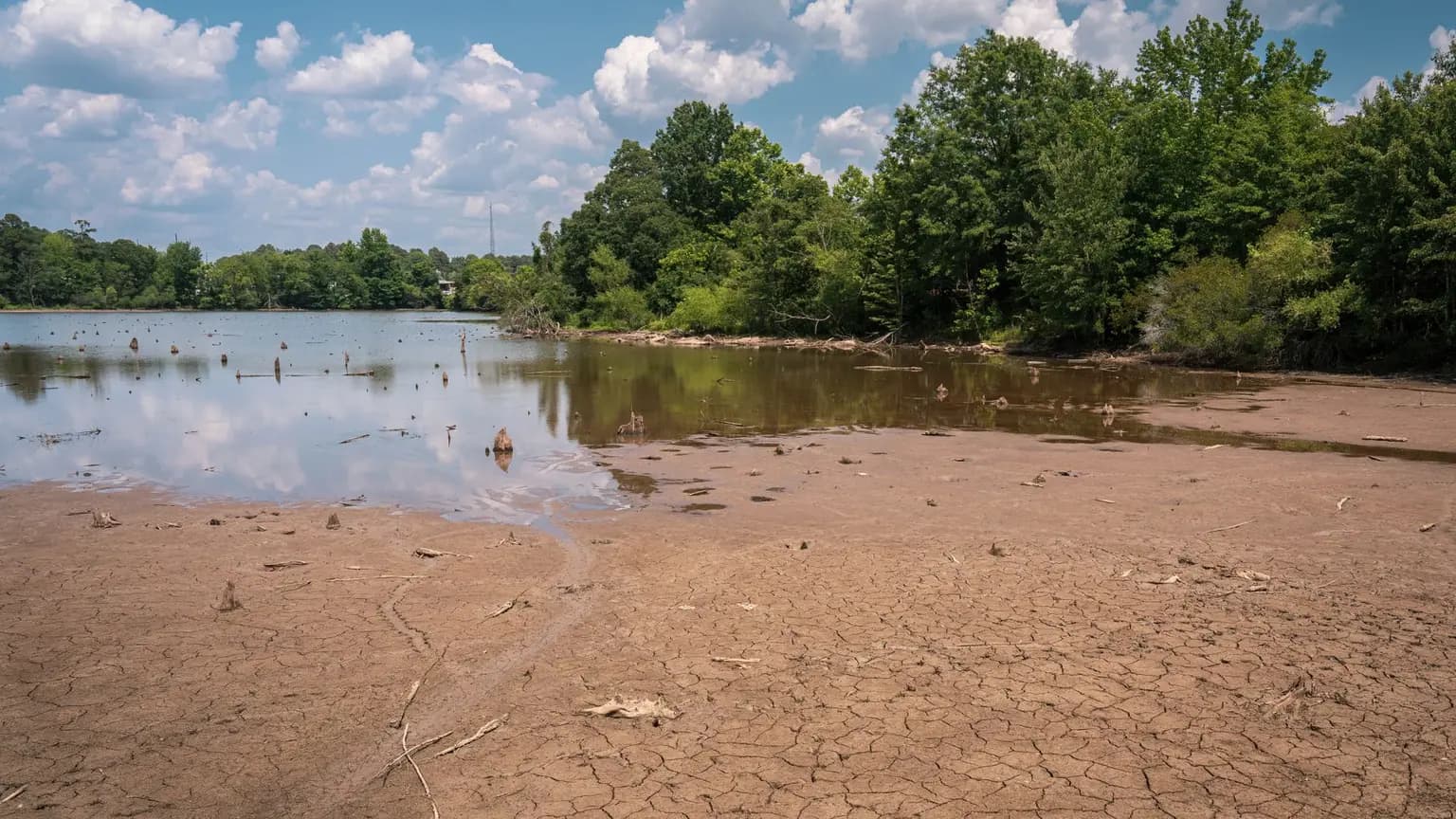
The surplus is gone. Lake Mead, the reservoir behind Hoover Dam that supplies water to 25 million people in Nevada, Arizona, and California, hit its lowest level in 2022 since the reservoir was first filled in the 1930s. Lake Powell, upstream, was barely better. The Bureau of Reclamation has imposed unprecedented cuts on downstream states, and Arizona farmers have had their allocations slashed.
And the Colorado is one river. Peter Gleick, co-founder of the Pacific Institute and one of the world's leading water researchers, has been documenting water-related conflicts for decades. His Water Conflict Chronology now contains over 1,300 entries: instances where water has been a trigger, weapon, or casualty of conflict. The database grows faster every year.
Underground theft
Surface water is visible. When a river or a reservoir disappears, people notice. Groundwater is different. You can drain an aquifer for decades before anyone realizes what's happening, because the effects are delayed and invisible right up until they're catastrophic.
The Ogallala Aquifer stretches beneath eight states in the American Great Plains and accounts for roughly 30% of the nation's agricultural groundwater use. It's being drained far faster than it recharges. In parts of Kansas and Texas the aquifer has declined by more than 150 feet, and land that was farmland a generation ago is reverting to dryland because there's nothing left to pump. The Ogallala took millions of years to fill. At current extraction rates, large sections will be functionally depleted within decades, and there is no replacement.
At least the Ogallala is being drained by Americans to grow American food. In Arizona, something stranger has been happening. Almarai, Saudi Arabia's largest dairy company, has been pumping Arizona groundwater, essentially for free under long-term leases on state land, to grow alfalfa for export to Saudi Arabia — which depleted its own aquifers through decades of unsustainable agriculture and then outsourced the problem to the American desert. Arizona residents get to watch their water table drop so that Saudi cows can eat.
None of this is a conspiracy theory. It has been reported at length by the Arizona Republic, ProPublica, and the New York Times. The leases were legal, the outrage was bipartisan, and the water is still leaving.
Day Zero is not hypothetical
Cape Town, South Africa, 2018. A city of four million came within weeks of shutting off municipal water entirely — an event officials called "Day Zero." Residents were limited to 50 liters per day. People lined up at natural springs. The agricultural sector lost an estimated 30,000 jobs. The city scraped past through severe rationing, emergency supply measures, and rain that finally arrived after a three-year drought. The crisis receded. The conditions that caused it didn't.
Chennai, India, 2019. The four reservoirs supplying a city of ten million went nearly dry. Water trucks became the primary distribution mechanism, and fights broke out around them. Hotels closed. Offices sent workers home. India's sixth-largest city functionally ran out of water.
Flint, Michigan, starting in 2014. A cost-cutting decision to switch the city's supply to the Flint River without proper corrosion treatment leached lead into the drinking water of 100,000 people, most of them Black, for nearly two years before officials acknowledged the problem. At least twelve people died of Legionnaires' disease linked to the water. Thousands of children were exposed to lead at levels known to cause irreversible neurological damage.
Flint wasn't a scarcity problem. It was a governance problem. The distinction matters less than you'd think, because the two failures feed each other. When water is abundant, bad governance is survivable. When it's scarce, it kills.
Privatization and who profits
In 2000 the Bolivian city of Cochabamba erupted in protests after the government, under pressure from the World Bank, privatized its water system. The new operator, a subsidiary of the U.S. corporation Bechtel, raised prices by as much as 200%. People who were already poor could no longer afford water, and even rainwater collection was technically prohibited under the concession contract. The protests became an uprising, remembered now as the Cochabamba Water War, and the government was forced to cancel the contract and return water to public control.
The privatization push didn't stop after that. It got quieter. Nestle and its competitors have spent decades buying up water rights and spring access across the developing world, bottling water from aquifers that communities depend on and selling it back to them at markup. In the American West, private equity firms are acquiring water rights on the bet that scarcity will make those rights more valuable. In 2020, water futures began trading on the Chicago Mercantile Exchange for the first time, which means you can now place a bet that someone's water supply will fail, and collect when it does.
The geopolitics of thirst
Water scarcity will reshape geopolitics more profoundly than oil ever did. Oil has substitutes — expensive, disruptive substitutes, but substitutes. Water has none.
The Nile is shared by eleven countries, and Egypt depends on it almost entirely for its freshwater. Ethiopia's Grand Renaissance Dam, completed on the Blue Nile, gives Addis Ababa significant leverage over downstream flows. Egypt has openly discussed military options. Given Egypt's military capacity, that conversation deserves more attention than it gets.
India and Pakistan share the Indus. The Indus Waters Treaty of 1960 has survived three wars, but it was negotiated when the glaciers of the Himalayas and Karakoram were stable. Those glaciers are retreating, and nobody is certain what the river's long-term flow will be. The treaty's assumptions about how much water exists no longer hold, and treaties don't tend to outlive their assumptions by much.
The Jordan River, the Tigris-Euphrates system, the Mekong: every major shared river basin in the world is under stress from some combination of population growth, agricultural demand, industrial use, pollution, and climate change. The institutions governing these basins were designed for conditions of relative abundance. Scarcity breaks institutions.
What comes next
Glaciers are retreating, which means less meltwater for the rivers that serve billions of people. Aquifers are being depleted faster than they recharge. Precipitation is becoming less predictable, more intense when it comes, with longer gaps between events. Demand keeps rising as populations grow and diets shift toward more water-intensive foods. None of these trends are reversing, and some are accelerating.
Whether the next century's water politics turn out cooperative or coercive is genuinely open, and I won't pretend the early evidence is encouraging. The people with the most water are selling it. The people with the least are dying quietly enough to stay off the evening news.
Very little of this registers in the countries best positioned to do something about it. What registers instead is the warning, republished every few months, that the water wars are coming. Somewhere right now the next version is being drafted, in a city where the tap still works.
Enjoyed this?
An email when I publish something new. That is the whole list; I have never sent it for any other reason.
Get notified when I publish new articles. Unsubscribe anytime.