Where Did Everybody Go?
Third places are disappearing because we priced out the conditions that made community happen for free.
Lorenzo ScaturchioLos AngelesAbout the author →
ExplorePlace & climateMoney & work
The empty stool
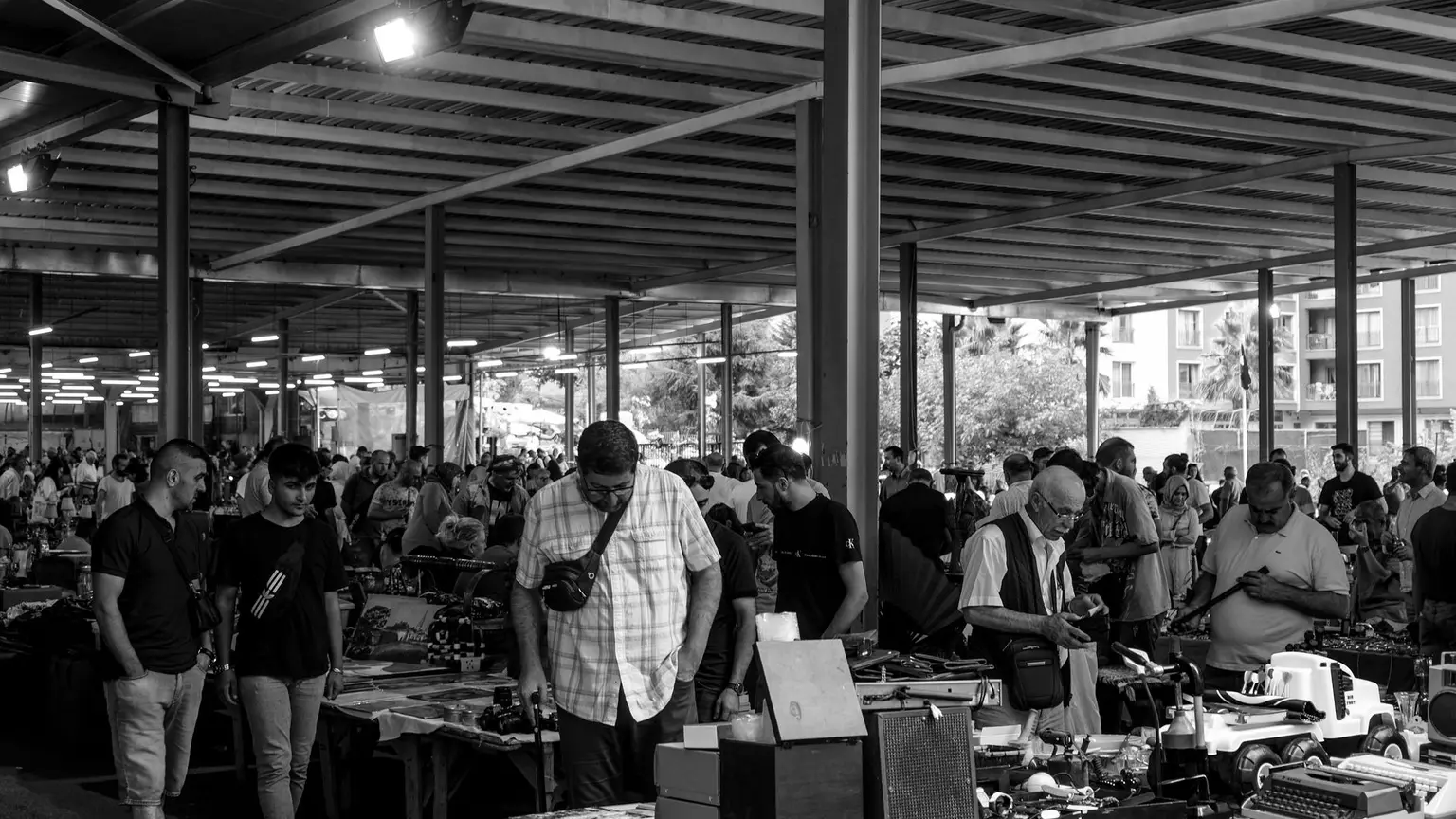
There used to be a diner near my old apartment. Formica counters, bad coffee, a cook who called everyone "hon." I went most mornings, and so did a retired postal worker, a woman who wrote romance novels, two nurses coming off the night shift, a guy who fixed motorcycles. We weren't friends. But we knew each other, and if one of us didn't show up for a week, someone would ask about it.
The diner closed in 2022. Rent tripled, a smoothie franchise moved in, acai bowls for fourteen dollars. Nobody sits at the counter anymore because there isn't one.
A small story. It keeps happening everywhere, which makes it the larger one.
The third place
Ray Oldenburg named the concept in 1989. Your first place is home, your second is work. The third place is everywhere else you go regularly: the bar, the barbershop, the park bench, the library, the diner counter. These are where community happens without anyone planning it. You show up, other people show up, and over enough mornings you become regulars. Eventually you become something like a community.
The places that work this way share a few traits. They're cheap to access and easy to reach. No reservation, no membership, nobody checking your credentials at the door. They tolerate lingering, and they put a retired plumber next to a college student and a night-shift nurse without anyone arranging it.
The sociological function is the part that's hard to replace. A third place is where you run into people outside your own circle and hear opinions you didn't go looking for. It's where loneliness gets interrupted by the plain fact of other humans being around, and where a newcomer gets absorbed through fifty small interactions instead of a formal introduction.
They're disappearing.
The economics of hanging out
The math is unforgiving. A third place has to be cheap, cheap means low margin, and low margin means you have no cushion when the rent goes up. In some urban markets rent has doubled or tripled over the past fifteen years.
Independent restaurants closed at a staggering rate during 2020 and 2021. The National Restaurant Association estimated that roughly 90,000 restaurants closed permanently in the first year of the pandemic alone. A lot of them were exactly the kind of place Oldenburg described: neighborhood joints where the overhead was low enough to let people nurse a cup of coffee for two hours.
What replaced them mostly moves people through fast. The business model of a Starbucks or a Chipotle is built around throughput. The chairs are uncomfortable on purpose, the music is loud on purpose, the WiFi cuts out after an hour on purpose. You're not a regular there. You're a transaction.
Even the coffee shops that advertise themselves as "community spaces" operate under pressures that cut against actual community. When your rent is $15,000 a month, you can't afford to let someone sit for three hours nursing a $4 latte. So the owner raises prices and pushes out the people who made it a community, or the place goes under.
Parks without people
Public third places, the ones that don't depend on commercial viability, should be the backstop. Parks, libraries, community centers, public pools. Places where you can exist without buying anything and the only price of admission is showing up.
The funding picture is grim. The National Recreation and Park Association has documented decades of underinvestment in park infrastructure. Adjusted for inflation, per capita spending on parks and recreation has declined in most American municipalities, and deferred maintenance backlogs run into the billions nationally. Parks get built when a new development needs one for marketing, then starved of the ongoing money that keeps them usable.
Libraries tell the same story. Hours cut, branches consolidated, programming reduced. The American Library Association has tracked steady declines in operating budgets relative to the populations these branches serve.
Then there's the open hostility. Anti-loitering ordinances. Benches with armrests that stop you from sleeping but also stop you from sitting comfortably. Skateboard-deterrent studs, parks that close at sunset. The physical infrastructure of public space increasingly communicates one message, which is keep moving.
Who is this for? Not the teenager who needs somewhere to be that isn't home or school. Not the retiree whose social world has contracted to almost nothing. Not the unemployed person who can't afford to buy their way into a private space. The people who need third places most are the ones being designed out.
The subscription model of socializing
What replaced the free third place is paid access. Gym memberships, coworking spaces, boutique fitness classes, membership social clubs, paid events through Eventbrite. Even dating, which used to happen incidentally in third places, now runs through apps you pay for.
Each of these works fine on its own. A climbing gym is a decent place to make friends, and a coworking space can grow its own regulars. But they all carry a cover charge, and a cover charge sorts by income. Social connection becomes a product you purchase instead of a condition you inhabit.
The distributional consequences should be obvious and somehow rarely come up. Wealthy people can buy their way into community: the gym, the coworking space, the social club. Their social lives are subsidized by disposable income.
Everyone else gets the couch and the phone. The places where they used to gather for free, the diner and the park and the library that stayed open until 9 PM, are gone or degraded or hostile. Their unstructured social time has been narrowed to the point where isolation stops being a choice and becomes the default.
The algorithm filled the vacuum
Social media didn't kill third places. It colonized the void they left behind.
When there's nowhere to go that doesn't cost money, the phone becomes the default third place. You scroll instead of sitting at a counter. You follow instead of knowing. The platform offers a simulation of the third-place experience, the regulars and the sense of belonging, without the embodied reality that made any of it mean something.
And the platforms are built to keep you there. Every minute you spend scrolling is a minute you're not at a park or a library or a diner, and the business model quietly depends on that. Connected people with full social lives don't generate the engagement metrics that drive ad revenue.
So the cycle reinforces itself. Third places close, people go online, the platforms profit from the loneliness, and the profits don't get reinvested into public space. More third places close.
What gets built instead
Drive through any American suburb built in the last twenty years and count the gathering places. You'll find a Starbucks in a strip mall, a gym in a commercial park, maybe a chain restaurant with a 45-minute wait. There'll be a "town center" that's actually an outdoor shopping mall: privately owned, security-patrolled, designed to facilitate purchasing rather than gathering.
What you won't find is a public square, or a community center with open hours, or a bar cheap enough that a retired plumber and a college student can sit next to each other for an evening.
We don't build those anymore. We build amenities for residential developments, a pool and a clubhouse restricted to the residents of one specific complex. Privatized third places for privatized communities, which is the exact thing Oldenburg was describing the absence of.
The fix is the space
We didn't lose community because people got worse at socializing. We lost it because we dismantled the physical conditions that let community happen without effort.
Rebuilding it means rebuilding the spaces. Fund parks and keep them open late. Fund libraries and extend their hours. Reform zoning so neighborhoods have commercial space woven into them, the corner bar and the cafe and the barbershop that's been there forty years. Repeal anti-loitering laws that criminalize existing in public. Design benches for sitting.
None of this is complicated, and all of it costs money. The money exists. It's being spent on highway expansion and stadium subsidies and tax breaks for developments that will never generate enough revenue to maintain their own infrastructure.
We didn't lose community. We priced it out, paved it over, and put up a sign that says Customers Only.
Enjoyed this?
An email when I publish something new. That is the whole list; I have never sent it for any other reason.
Get notified when I publish new articles. Unsubscribe anytime.