
Climate Change Is a Labor Issue
The workers who extract, transport, and burn fossil fuels are the same ones who'll build what comes next. Climate transition requires labor organizing.
Lorenzo ScaturchioLos AngelesAbout the author
ExplorePlace & climatePower & institutionsMoney & work
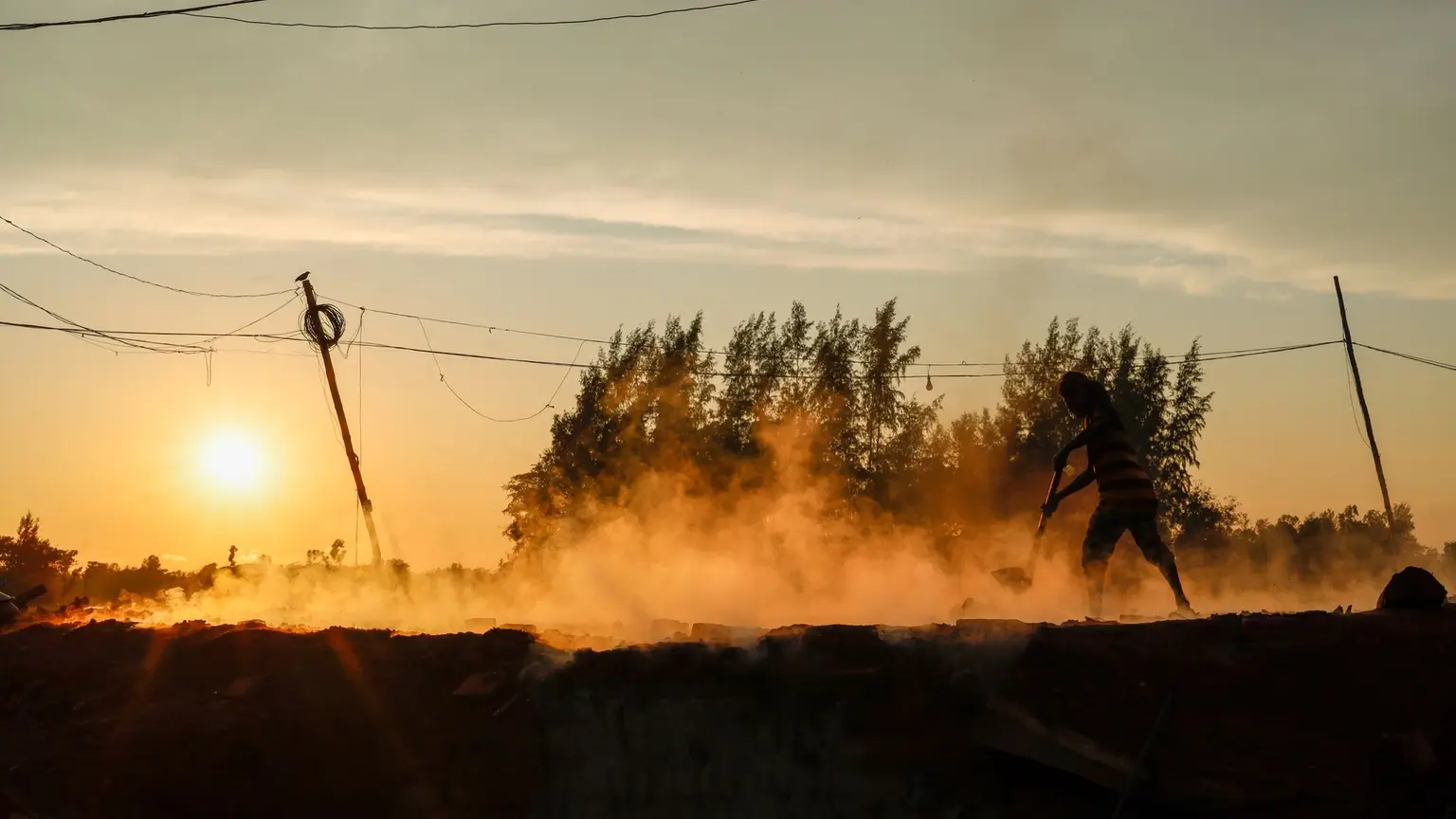
The pipeline workers aren't your enemy
The guy welding pipeline sections together isn't the problem. He could be the solution, and environmentalists keep missing it.
The climate movement has spent decades talking about emissions targets, carbon budgets, and temperature thresholds, all of it necessary. But a blindspot opened up underneath the targets. Who is supposed to build the post-carbon economy? Who installs the millions of solar panels, retrofits every building in the country, lays the high-speed rail, manufactures the wind turbines?
Workers. The same workers currently employed in fossil fuel industries.
Skills transfer isn't automatic
A coal miner doesn't become a solar installer because someone passed legislation. A petrochemical plant operator doesn't wake up qualified to run a battery factory. Climate policy often proceeds as though these transitions happen by themselves. They don't.
The workers in fossil fuel industries already have most of the skills decarbonization needs. Electricians, welders, heavy equipment operators, pipe fitters, chemical engineers: these are the trades that built the carbon economy, and they're the trades that will build whatever comes next. But only if someone bothers to organize the transition.
Most climate proposals treat workers as an afterthought. "Job training programs" get mentioned in passing, usually in the final paragraphs, a few billion dollars allocated here, some vague promises there. It's not serious, workers know it's not serious, and that's why many of them view climate policy with suspicion.
The political failure
In regions dependent on extraction industries, climate proposals are often heard as existential threats. Not because people don't believe in climate change (most surveys show broad acceptance of the science) but because they don't trust that anyone has a plan for what happens to them. That distrust is earned.
Deindustrialization already happened once in many of these communities. Manufacturing left, nothing replaced it, and entire regions were written off as sacrifice zones. When environmentalists show up talking about shutting down the coal plant or canceling the pipeline, people hear "we're going to do to you what free trade did to the rust belt."
The failure here is political, not scientific. Climate advocates have largely failed to build genuine coalitions with labor. Some of that is mutual, since unions have often aligned with fossil fuel interests out of short-term self-preservation. But environmental movements have also been dominated by professional-class activists who treat blue-collar workers as obstacles rather than allies.
What labor organizing actually offers
Strong unions do something no amount of policy wonkery can: they give workers collective power to negotiate the terms of transition.
A workforce without organization has no leverage. They take whatever retraining programs get offered, if any, accept whatever severance is provided, if any, and hope for the best. Usually the best doesn't arrive.
An organized workforce can demand binding commitments instead. Wage guarantees during transition, benefits that follow workers between industries, community investment funds that don't evaporate after the ribbon-cutting, a say in what gets built and where. Managed industrial transitions are possible, but only when workers have enough power to enforce accountability. Without it, promises made during campaign season get forgotten once the legislation passes.
The green jobs myth (and how to make it real)
There's been a lot of talk about "green jobs" over the past fifteen years, and most of it is marketing.
Solar installation work is often low-paid, non-union, and precarious. Wind turbine manufacturing has frequently been offshored. Electric vehicle production happens in factories that have aggressively resisted organizing. The green economy as currently constituted often means worse working conditions than the industries it's supposedly replacing.
It doesn't have to. Green jobs could pay union wages, offer real career paths, and provide the stability that lets people build lives where they live. That only happens if workers have the collective power to demand it.
The choice isn't between climate action and workers' interests, whatever the people who benefit from worker disorganization want you to think. The real choice is between a transition that serves corporate interests (low wages, weak regulations, maximum profit extraction) and one that serves working people.
Beyond job training
Job training is the go-to policy response whenever industrial transition comes up. On its own it's insufficient, and often counterproductive.
Training programs assume the problem is individual skill deficits. They locate the issue in workers themselves, as though the guy who spent twenty years maintaining drilling equipment just needs to learn JavaScript and everything works out.
The actual problem is structural. Communities built around extraction don't only need new job skills; they need new economic foundations: investment in physical infrastructure, in social services, in the basic fabric of community life. They need planning processes where the affected communities have real decision-making power over their own futures. Job training designed by distant bureaucracies and delivered by for-profit contractors isn't going to do that. Comprehensive regional investment controlled by the people who live there might.
The path forward
Climate transition is going to happen one way or another. The physics are non-negotiable, carbon-intensive industries will shrink, and the only open question is whether that shrinkage is managed in a way that serves working people or abandons them.
Organized labor is the institutional mechanism for the first option. Unions are how workers negotiate transition terms, enforce commitments, and keep the burden of decarbonization from falling hardest on the people who can least afford it. Environmental movements need that, and labor needs climate policy that treats worker interests as a starting premise rather than an afterthought.
The alternative is the rust belt again: deindustrialization without worker power, devastated communities, justified resentment, and political instability that makes every other collective problem harder to solve. We've already watched that movie once.
So picture the pipeline welder and the climate activist on the same side of the table, arguing over what gets built and who gets paid to build it. That table is the whole thing. It either exists or it doesn't, and right now it mostly doesn't.
Enjoyed this?
An email when I publish something new. That is the whole list; I have never sent it for any other reason.
Get notified when I publish new articles. Unsubscribe anytime.