
Borders Are Newer Than You Think
The modern border regime is barely a century old, and pretending otherwise distorts every immigration debate we have.
Lorenzo ScaturchioLos AngelesAbout the author →
ExplorePower & institutions
A hundred years of pretending
The modern passport didn't exist before World War I. The border as a bureaucratic checkpoint, the thing you picture when someone says "border security," with fences and guards and papers and stamps, is roughly a century old. For most of human civilization it simply wasn't there.
People moved. They always moved, migrating in response to seasons, resources, conflict, opportunity, curiosity. The idea that a line on a map should determine who gets to live where, and that crossing it without the right paperwork is a crime, is recent. The fact that it feels ancient and inevitable tells you more about how institutions naturalize themselves than about any inherent logic of territorial sovereignty.
Before the passport
For most of the 19th century, Europeans moved across the continent without papers. The British didn't need passports to travel to France. Germans migrated freely to the United States. The Ottoman, Habsburg, and Russian empires were vast multiethnic territories where people moved internally with minimal documentation.
The United States had effectively open borders until the 1880s, when the Chinese Exclusion Act became the first significant restriction on immigration based on nationality. Before that, you showed up. That was the process. Ellis Island, which opened in 1892, processed roughly 12 million immigrants between 1892 and 1954, and the average processing time was a few hours. Most people walked in, answered some questions, got a medical check, and were admitted the same day.
The current system runs differently. A legal immigration case can take years or decades; asylum seekers wait months for a hearing; the backlog for certain visa categories from certain countries stretches past 20 years. We went from processing people in hours to processing them in generations, and somehow convinced ourselves this counts as progress.
The war that changed everything
World War I is when borders hardened. The belligerent nations needed to control movement, to prevent espionage and manage labor supplies and track populations. Passports, which had existed in various informal forms, became mandatory. Exit visas appeared, checkpoints proliferated, and the free movement that had characterized the previous century evaporated almost overnight.
In 1920, the League of Nations held a conference on passports and customs formalities, with the explicit goal of standardizing travel documents across nations. What emerged was the ancestor of the modern passport system, a temporary wartime measure that was supposed to be rolled back once peace stabilized.
It never was. The bureaucracy that grew up around border control developed its own institutional momentum, its own budgets, its own constituencies. By the time anyone might have argued for a return to prewar openness, the infrastructure was too entrenched to move.
John Torpey, the sociologist who wrote The Invention of the Passport, traces this arc meticulously. The state's monopolization of "the legitimate means of movement" parallels its monopolization of the legitimate means of violence. Both are recent. Both feel eternal. Neither is.
The US-Mexico border before it was a "crisis"
For most of its history the US-Mexico border was something closer to a suggestion than a barrier. Reece Jones documents this in Violent Borders: until the mid-20th century the border was lightly patrolled, and people crossed for work, for family, for commerce. The Bracero Program, which ran from 1942 to 1964, formally brought millions of Mexican workers to the US for agricultural labor. When it ended, people kept coming, because the economic logic hadn't changed, only the paperwork requirements.
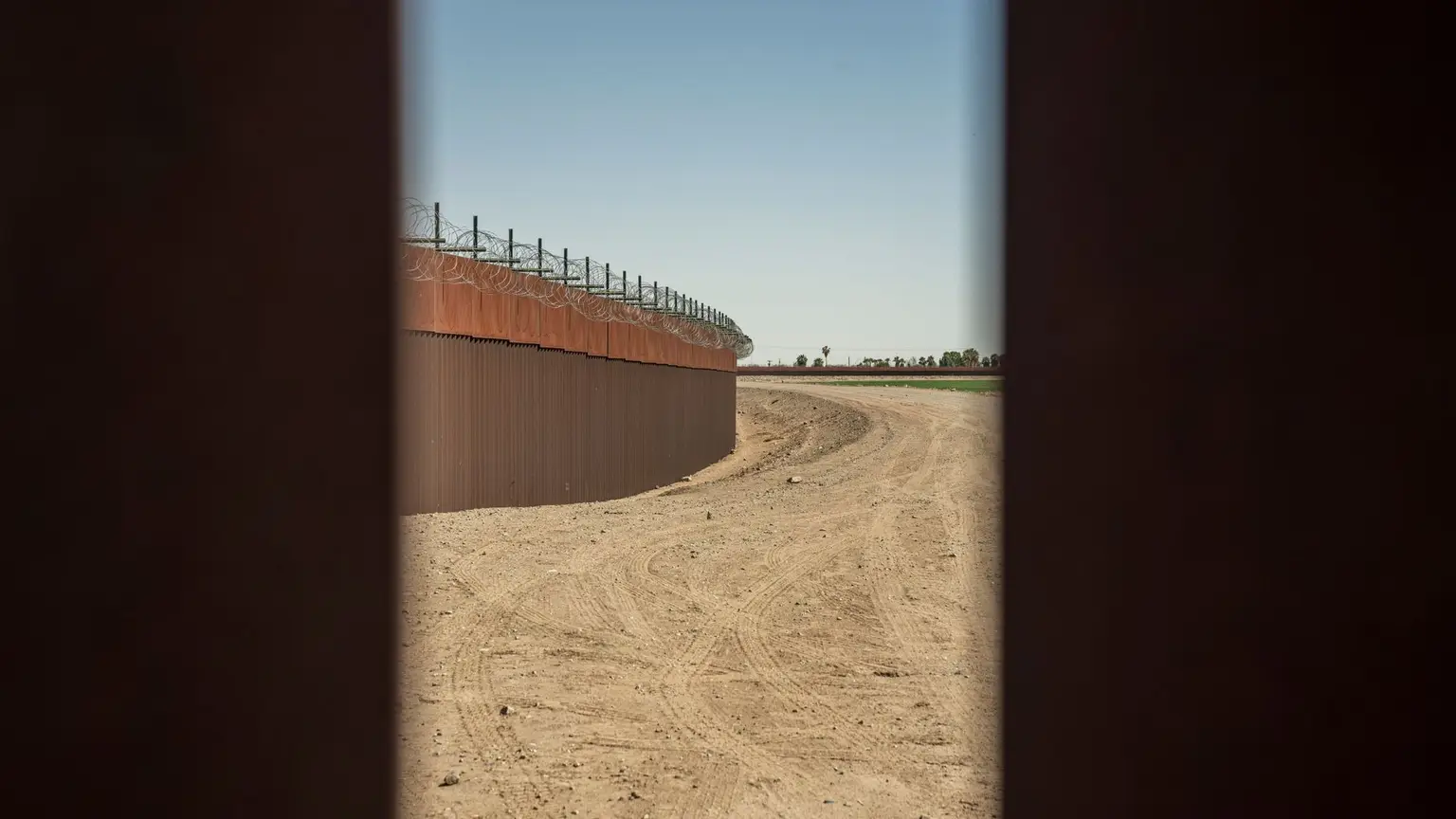
The modern enforcement apparatus is shockingly recent. Operation Hold the Line in El Paso started in 1993; Operation Gatekeeper militarized the border near San Diego in 1994. The escalation of fencing, surveillance technology, and enforcement personnel is a phenomenon of the last thirty years, not the last three hundred.
Before that, the pattern was circular migration: come for the season, return home, repeat. The wall didn't stop the migration. It disrupted the circularity. When crossing became dangerous and expensive, people who used to come and go decided to come and stay, and the enforcement created the permanent undocumented population it claimed to prevent.
Douglas Massey, a Princeton sociologist who has studied Mexican migration for decades, has documented this paradox extensively. Every major increase in border enforcement has correlated with an increase in the permanent undocumented population. The wall didn't keep people out. It kept people in.
Schengen and the proof of concept
If you want to see what relatively open borders look like in the modern world, look at the Schengen Area: twenty-seven European countries, 420 million people, no border checks for internal movement. A French citizen can drive to Germany, take a train to Italy, and fly to Portugal without showing a passport once.
When Schengen was proposed, critics predicted what critics of open borders always predict. Mass migration from poor countries to rich ones. Wage depression. Welfare tourism. The collapse of social order.
None of it happened. Migration within the Schengen Area is modest; most people stay where they are, because moving is hard and people have lives. The EU's free movement provisions have existed in some form since 1957, and the welfare states have not collapsed. Rich countries are still rich. Poor countries have gotten richer, in part because the freedom to move creates economic dynamism.
Europe's immigration situation is not simple, and nobody should pretend it is. But the Schengen experiment shows that controlled open borders between countries are possible and economically productive. The dire predictions failed to materialize, the way they've failed every other time someone has opened a border and waited.
Who borders serve
Borders are not primarily about security. They're about labor control.
When you restrict the movement of people but allow the free movement of capital, you create a system where workers are trapped in low-wage markets while money flows to wherever returns are highest. A factory can move from Michigan to Juarez, but a worker can't move from Juarez to Michigan. Capital is global; labor is caged.
The same politicians who champion free trade agreements, the free movement of goods and money, turn around and demand stricter immigration enforcement. They want open borders for everything except human beings. The asymmetry is the point. It keeps wages low by ensuring that workers can't follow the jobs.
Branko Milanovic, the economist known for his work on global inequality, has argued that the single most effective anti-poverty intervention in the world would be to allow free migration. His research shows that most global income inequality is explained not by what you do or how hard you work, but by where you were born. Two people with identical skills and identical work ethic, one born in Denmark, one born in the Democratic Republic of Congo, will have wildly different incomes, entirely because of which side of a border they happened to enter the world on.
Borders enforce that lottery. They make geography destiny.
The story we tell
The story we tell about borders is one of permanence and inevitability. Nations have always had borders. Sovereignty requires them. Without them, civilization dissolves.
The history says otherwise. Borders as we know them are a product of early 20th-century bureaucracy, wartime paranoia, and institutional inertia, enforced unevenly and militarized only recently. The passport is younger than the airplane. The surveillance state at the border is younger than the internet.
None of this means you have to support fully open borders tomorrow. It means you should stop treating the current system as natural law. The borders you grew up with are political choices, maintained by political power, serving political ends. They have been different before, and for most of human history they didn't exist at all.
The passport is younger than the airplane, and we decided, fairly recently, that a line on a map was worth more than the person trying to cross it. That decision can be unmade. Knowing when it was made is where the unmaking starts.
Enjoyed this?
An email when I publish something new. That is the whole list; I have never sent it for any other reason.
Get notified when I publish new articles. Unsubscribe anytime.