AI Art and the Death of Process
The debate about AI art focuses on output quality. That misses the point entirely.
Lorenzo ScaturchioLos AngelesAbout the author →
ExploreTechnology & attention
The wrong argument
Most of the debate about AI-generated art is about whether it's any good. Whether the outputs are indistinguishable from human work, whether a prompt engineer deserves to be called an artist, whether the training data was ethically sourced.
These are the wrong questions, because they treat art as a product — something you judge by looking at the finished object, holding it next to other finished objects, and deciding whether it passes. By that logic a perfect replica of the Mona Lisa is equivalent to the original, and a microwave dinner is the same as the home-cooked one it imitates.
We know that's wrong somewhere below argument. But the conversation keeps circling back to outputs anyway, because outputs are easy to compare and process is invisible. So let's talk about process.
What 200 hours teaches you
Richard Sennett, in The Craftsman, argues that skill develops through a specific kind of repeated engagement with materials. The woodworker who has spent ten thousand hours at the lathe doesn't just produce better chairs; they have a different relationship with wood. They read grain, tension, moisture, the way the material answers back. This isn't mysticism. It's embodied knowledge, the kind that lives in your hands and your peripheral vision and the part of your brain that fires before conscious thought arrives.
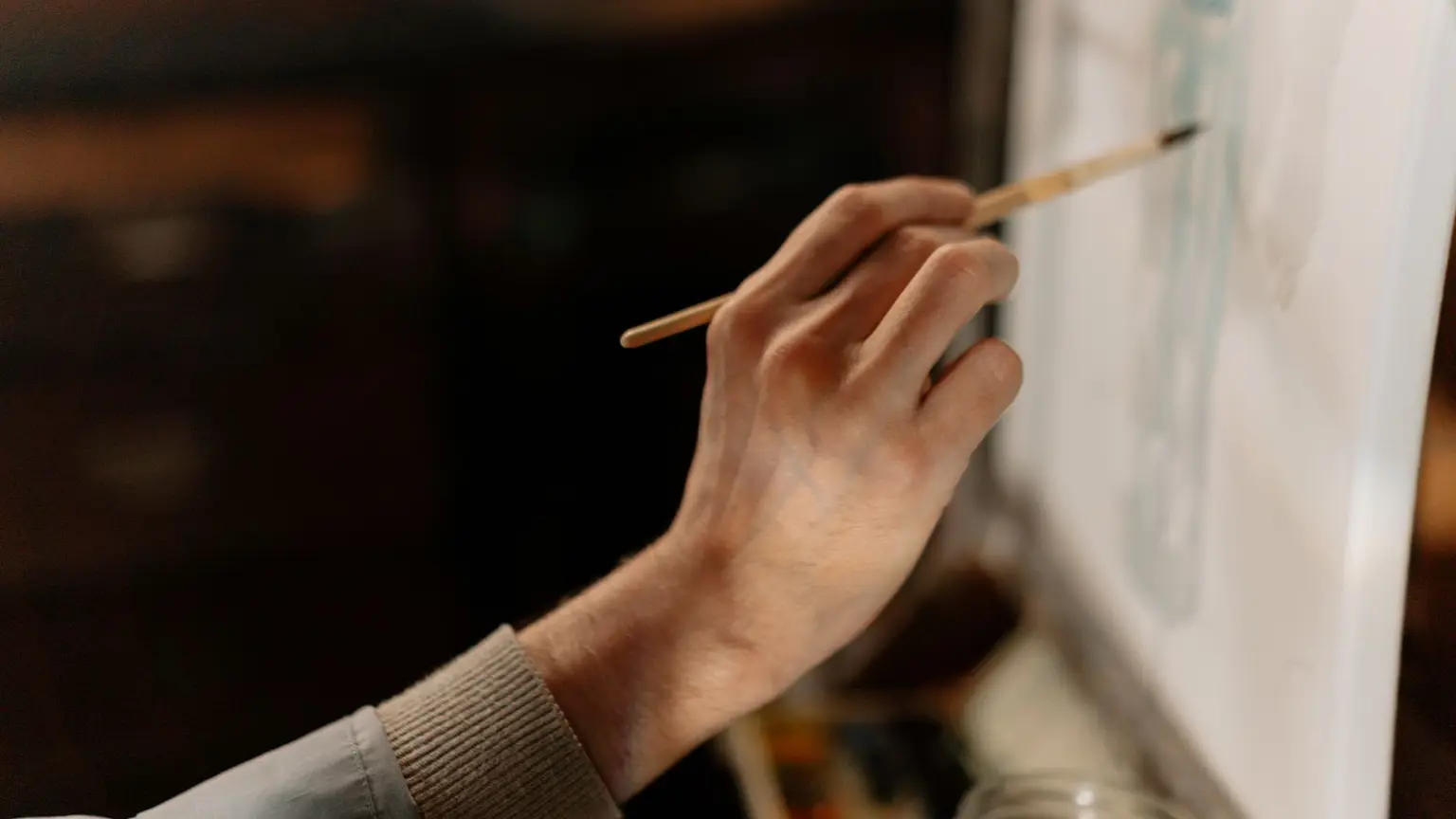
A painter who spends 200 hours on a canvas is changed by those hours. Every stroke is a decision that feeds back: the paint resists or flows, the color shifts in ways you didn't predict, the composition reveals problems you couldn't see in the sketch. You adjust, and you learn. The painting teaches you how to paint it, and along the way it teaches you something about seeing.
A prompt that takes 30 seconds teaches you how to write prompts. That's the entire pedagogy.
The efficiency trap
The argument for AI art tools usually runs like this: the output looks just as good and took a fraction of the time, so why wouldn't you use the faster method?
That logic is correct if you're running a content farm. If you need 500 product images by Thursday, generate them. If you need a stock illustration for a blog post and your budget is zero, fine. But applying assembly-line logic to human expression is a category error. Efficiency is a value that belongs to production, and the part of art that matters isn't the production part.
Matthew Crawford makes a related argument in Shop Class as Soulcraft. He writes about the mechanic who diagnoses an engine by listening — not by running a diagnostic scan, but by listening. The scan would be faster and might even be more accurate. But the mechanic's way of knowing is a different thing entirely: a form of attention, of being in relation with the machine, that the scan removes. Optimize for speed and output quality and you're saying that relation doesn't count, that the only thing worth keeping is the artifact at the end.
Flow states and the making of meaning
Mihaly Csikszentmihalyi spent decades studying flow, the state of complete absorption in a challenging activity. His research, across cultures and disciplines, found that flow states are among the most meaningful experiences people report, and that they share specific conditions: the task has to be hard enough to demand full engagement, the feedback has to be clear, and you have to feel some agency over what happens next.
Making art, when it's working, is a flow state. The hours disappear. You're solving problems in real time that the medium keeps generating. The clay cracks. The chord progression doesn't resolve the way you expected. The paragraph needs a sentence that hasn't been written yet and you can feel its shape but not its words.
Prompting an AI model is a transaction. You describe what you want, you get a result, you refine the description. The loop exists, but it's thin. You're negotiating with a black box rather than working a material that pushes back in ways you can learn from. This isn't snobbery so much as a description of two different cognitive experiences. One leaves something behind in the maker; the other hands you a deliverable.
The skill collapse
The long-term consequence I worry about isn't a world without art. There will always be people who paint and sculpt and compose because the process itself sustains them. It's a world with far fewer people who can.
If a passable illustration takes thirty seconds, why would a young artist spend years learning to draw? If a film score comes out of a prompt, why would a student grind through music theory and ear training and the humbling experience of playing badly in front of other people? For some of them the answer is that they wouldn't, and we'll lose something that doesn't appear in any single image or song: a population of people who know what it is to struggle with a medium and come out the far side holding a skill they didn't walk in with.
Those skills aren't only instrumental. They're constitutive. Learning to draw changes how you see, learning music changes how you hear, and learning to write — really write, through the drafting and revising and confronting your own muddy thinking — changes how you think. None of that transfers when a machine does it for you, any more than watching someone else lift weights builds your back.
The patron problem, again
When photography was invented, painters panicked, and the panic was partly justified: portrait painting as a trade collapsed. But painting didn't die. Freed from the job of representing reality accurately, painters went off into abstraction and expressionism and the rest of the movements that made twentieth-century art what it was. AI art advocates love this analogy. New tools just push art in new directions.
The analogy breaks in a specific place. Photography didn't replace the process of making visual art; it replaced one application of that process. Photographers still needed skill, vision, timing, an eye for light and composition. The camera extended human capability without removing human agency. AI image generation replaces the process itself, reducing the human contribution to description — telling the machine what you want. That's closer to being a patron than an artist. The Medici didn't paint the Sistine Chapel; they told Michelangelo what they wanted and he figured out how to do it.
Prompt engineers are the new Medici. That's fine as far as it goes. Patronage is a legitimate role. It just isn't artistry.
What we actually lose
We're not losing art. The world is about to be flooded with more images and music and text than any previous era produced, by a wide margin.
We're losing artists. People who have been altered by the slow, frustrating, irreducibly human work of wrestling something into existence, who can see things the rest of us can't because they've spent thousands of hours training their perception through the act of making. That loss won't show up in any output metric. You can't find it by comparing generated images to painted ones. It lives in the gap between a person who has made things and a person who has described things to a machine.
The artifact was never the art. The process was. The process is what's dying.
Enjoyed this?
An email when I publish something new. That is the whole list; I have never sent it for any other reason.
Get notified when I publish new articles. Unsubscribe anytime.